A FASSTEST funded project from the Faculty of Arts and Social Sciences at The Open University.
Tutor/Researcher: Dr Cora Beth Fraser
Project Co-ordinators: Dr Trevor Fear
‘Relaxed’ events are held across the Arts sector as a way of accommodating neurodiverse audiences. From reduced-volume cinema showings, to early museum openings, to informal pantomime performances, Arts and Heritage organisations have been taking steps to make events accessible to all. There is now a widespread recognition that simple changes to reduce social and sensory pressures can make a huge difference to the experience of visitors with autism, sensory sensitivities or anxiety; and in many places those changes have now become as accepted and expected as signed performances or audio-described showings.
The Relaxed Tutorial Project is setting out to investigate what happens when similar changes are made in an educational setting.
Higher Education institutions do not always provide welcoming environments for neurodivergent students who might struggle with communication, verbal instructions and group dynamics. ‘Student engagement and participation’ is a phrase which has in recent decades come to dominate the discourse of teaching and learning at universities, along with ‘active learning’, ‘The Guide at the Side rather than The Sage on the Stage’, and other formulations which assert the superiority of a particular form of learning and teaching. At the same time, ‘lurkers’ are stigmatised, particularly in online environments, as students who do not make a contribution to the group. Quiet, solitary learning is out of fashion, and has been replaced by the expectation of visible and even measurable participation.
The ‘tyranny of participation’ has been seen (Gourlay 2015) as a problem of policy, training and metrics; but it has its roots in ableist perceptions of desirable interaction. Common in scholarship (eg. Coates 2007) is the contrast of ‘active’ with ‘passive’ learners. This championing of active learning is the current norm in the literature, and can be exacerbated by unacknowledged ‘positionality’ and ‘insiderism’ (Macfarlane and Tomlinson 2017: 10) on the part of researchers whose values support a definition of conspicuous activity as effective, and whose research is funded by schemes which seek to establish a link between activity and effectiveness.
The Relaxed Tutorial Project seeks to investigate what happens when we stop prioritising visible interactivity in a learning environment, and instead prioritise comfort, the removal of pressure, and the accommodation of complex needs including neurodiversity, caring responsibilities and social anxiety.
Following best practice in the Arts and Heritage sector, as part of The Relaxed Tutorial Project we have drawn up a set of guidelines which are sent out to students as a statement, setting out the types of interaction which will not be required in an online Relaxed Tutorial session.
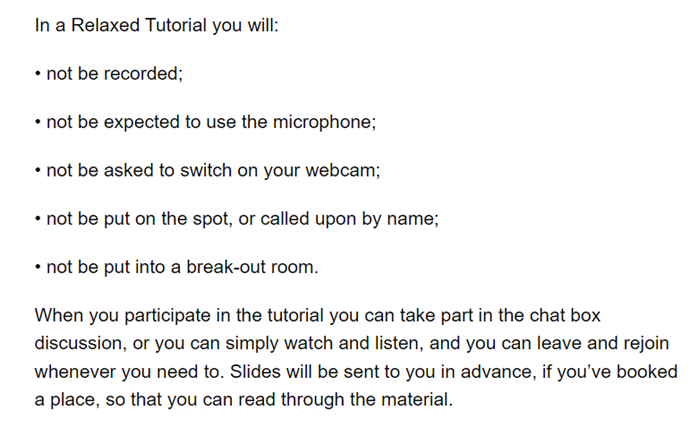
The purpose of this statement is to tackle the anxiety felt by many students when they don’t know what to expect, and to remove common concerns about webcam use, being ‘put on the spot’, or having to interact with a peer group without preparation. Our project is designed to investigate whether these adjustments result in an improved learning experience for some students.
The Relaxed approach is not suitable for all students, nor would it be appropriate as a dominant mode of teaching, since many students learn by doing, and group discussion will always be a valuable teaching tool. That’s why the Relaxed label is only applied to one out of every set of Learning Events (online tutorials hosted at the same point in the module by different tutors, from which students can pick). The point of the Relaxed Tutorial Project is to offer an additional option, not a replacement or a wholesale shift in pedagogy.
Our objective is to enable more students to achieve their study goals, by offering a mode of tuition which might be appealing to students who tend to avoid tutorials altogether, and by reducing anxiety in those students who attend tutorials only reluctantly. Our adjustments focus on the access needs of neurodivergent (and particularly autistic) students; but as with any accessibility adjustments, we expect that the benefits will be felt beyond the target group.
The Project is being trialled on module A340: The Roman Empire. This is a Level 3 (third-year undergraduate) Classical Studies module, taken by students who typically have two to five years’ experience of Open University tuition. All tuition is currently online, due to the COVID-19 pandemic.
Relaxed Tutorial sessions, led by Dr Cora Beth Fraser, will take place throughout the academic year 2021-2. Attendance figures and reports will be compiled, and optional surveys will be sent out at the end of the academic year. A full report will be made available upon the completion of the project, in Summer 2022. In the meantime, if you would like to find out more about the project, please contact Cora Beth at CoraBeth.Fraser@open.ac.uk.
References
Coates, H. (2007) ‘A Model of Online and General Campus-Based Student Engagement’, Assessment and Evaluation in Higher Education 32.2, 121-141.
Gourlay, L. (2015) ‘”Student engagement” and the tyranny of participation’, Teaching in Higher Education 20.4, 402-11.
Macfarlane, B. and M. Tomlinson (2017) ‘Critiques of Student Engagement’, Higher Education Policy 30.1, 5-21.
Featured in the Neurodiverse Classics: Constructive Connections panel at the Classical Association Conference 2022. Watch our video below!