by Latifa Walker
Music connects us. It connects us to places, events, memories, emotions, each other and those who came before us. For our ancestors – including the ancient Greeks – music was a part of their everyday lives. Music was associated with events such as theatrical productions, weddings, and religious ceremonies, as it is for us. And like us, the ancient Greeks learnt to play instruments, taught, sang, performed both at amateur and professional level, and danced to music.
Storytelling and music went hand-in-hand with mythology and mythological characters, including the Elvis Presley of Myth, the lyre-playing singer/poet Orpheus who, like Elvis, enchanted all who heard his music – and of course the god of music himself, the lyre-playing Apollo. (The real Elvis Presley was represented as a Greek god in the media as far back as 1956, and bought a giant bust of Apollo for his house ‘Graceland’ because he thought it looked like him. The likeness is uncanny!)
Music not only connects us to those who came before us, but it can also connect us with ourselves. We use it in our lives today in many different ways – some of us use music to relax, escape, study, focus, expel pent-up energy and emotion, convey a feeling, for inspiration or artistic expression. And of course, for pleasure when we are just a big fan of a certain band or artist and can listen to the same album (or song!) on repeat all the livelong day!
Escaping with a pair of headphones and focusing on our favourite tunes can be a welcome haven from the constant flood of information and stimuli, for those of us who struggle to tune out unwanted, distracting and sometimes painful auditory and visual noise, which often results in things such as anxiety, fatigue, migraine and sometimes sensory overload. For some of us, listening to music in busy places, such as train stations or the London Underground, helps us to focus our senses. With a whole combination of things bombarding us – the glare of bright or flickering lights, information on multiple screens, loud conversations, announcements and the banshee-scream of the Underground, and not forgetting temperature (too hot/cold), motion sickness and crowds – music can help us to stay calmer and more focused.
A very brief example of a type of constant intake of information is in the form of a song and music video from the band ‘Nightwish’ (we will meet them again later) aptly titled ‘Noise’. This is a good representation of the constant stimuli, particularly from smartphones and social media, that we are exposed to in our modern lives. There are also some symbolic details in the video for those of us who enjoy spotting detail!
An overload of stimuli can be like being tuned into multiple TV channels and radio stations at once, or having multiple open tabs in your web browser. Instead of the channels, stations and tabs queuing in an orderly manner and waiting their turn, they jump the queue, or play all at once. Thoughts, ideas, snippets of past conversations heard, the same phrase from a movie or TV show popping up randomly – they’re all battling for air-time in our minds.
Along with using music to help focus in busy places such as train stations, as a student I also use music to help focus my thoughts for study sessions. For some of us with anxiety and a constant array of intrusive thoughts, music can help us to focus on one thing – the music itself. Once we are focused on the music itself, we can focus on the task at hand, such as studying, writing a paper, reading a book or beginning a sat exam with relatively focused mind. There is nothing like an uplifting or melancholy melody to help.
The oldest surviving melody, most historians agree, is a beautifully haunting melody titled ‘Hurrian Hymn No. 6’. The Hurrians were an ancient people who lived across western Asia around the 4th – 1st millennium BCE. Clay tablets containing the hymn, along with others, written in cuneiform were found amongst the ruins during excavation of the ancient city of Ugarit in Syria during the 1950s. The hymn is a song dedicated to the goddess Nikkal, and with it came an almost complete music notation and a sort of ‘How-to-play’ and tuning guide for a nine-string lyre. It’s wonderful to connect with the ancient world through their own form of what we call ‘sheet music’ – we could imagine the ancient Hurrian lyre maker reproducing the lyre and ‘how to play’ guides to sell as a beginners package, just like we do now!
The Hurrian Hymn No. 6 has been interpreted in many different ways since it was discovered. As the gifts of music and storytelling were passed on through the generations, they were embellished and reimagined, evolving with our ancestors and continuing to evolve through us.
Music can take us on an adventure. You’re warmly invited to come along on one of mine!
We can begin by travelling with Nightwish through Music:
…and go back in time with the reimagined Hurrian Hymn No. 6.
Go back to childhood and sneak out of our windows with The Escapist?
Maybe take a mythology-inspired journey with Pan?
We could sail through the seas, giving in to the hypnotic lure of The Siren…
…or make our way through the epic Sahara desert.
(For those of us who like to watch live bands here is a live version of Sahara and a live version of The Greatest Show On Earth to immerse ourselves in – WARNING: these videos contain some flashing lights and strobe effects.)
If you chose to take this mysterious journey with Nightwish, may it bring you focus, pleasure, inspiration or escapism…. or may you find your own musical journey that does all of this and more.
This blog post is written from the author’s perspective on sensory processing and music. The uses of “we” and “us” are intended to create a feeling of inclusiveness, and do not speak for everyone.
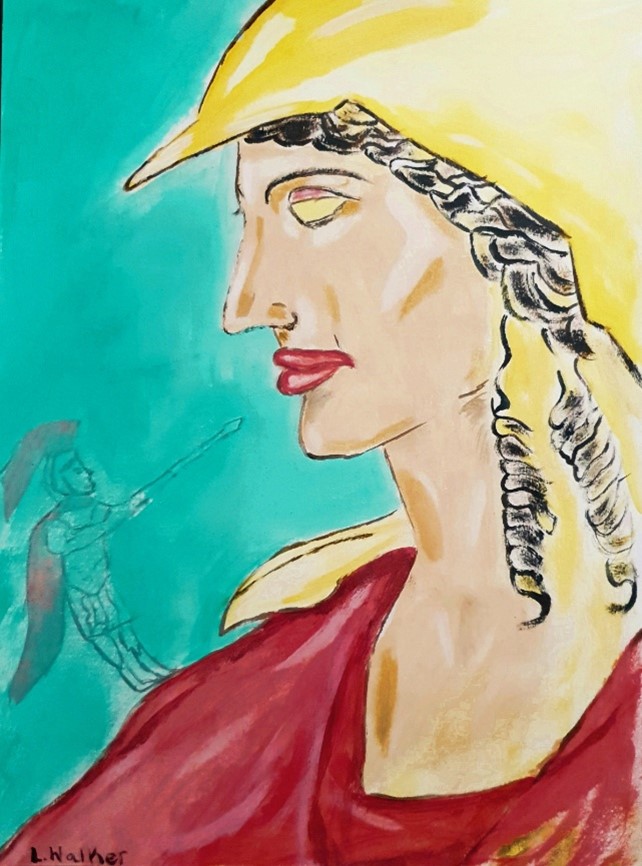
Athena in Focus. Original Illustration by Latifa Walker, 2021
Further Reading
Andrews. E (2018) ‘What is the oldest known piece of music?’, History ‘History Stories’, 1st September.
Hornblower. S (ed), and Spawforth. A (ed) 2004 ‘Music in Greek and Roman Life’, in Hornblower. S (ed), and Spawforth. A (ed) in The Oxford Companion To Classical Civilisation, New York, Oxford University Press. pp.477-497.
Lawler. A (2008) ‘Who Were The Hurrians?’, Archaeology, Vol. 61 Number 4, July/August 2008.
Links you might find helpful
https://www.mind.org.uk/information-support/your-stories/music-and-my-mental-health/




0 Comments